Showing posts with label Daihatsu. Show all posts

Monday, July 19, 2010

2010 Daihatsu Design Cars Materia by Inden-Design

The company is now branching out a bit, and turning their sites on the sub-€15,000 Daihatsu Materia. German tuners Inden-Design is better known for their work on high-priced models from Ferrari and Mercedes. Dubbed the "Icecube," the bright white box has been outfitted with a host of new items. On the exterior, the new body kit contains four different extensions that can be attached over the current panels, as well as a daytime lights, and a new rear bumper with diffuser. Triangle-shaped side mirrors and carbon fiber door handles and boot cover are also installed.
The Inden-Design Tuner has modified the new ICECUBE cars both from optical and from the technical point of view at the same time. This resulted in the creation of the rough look. The Daihatsu ICECUBE Materia creates a convincing outfit by innovative design and exemplary functionality at a car tuning level. The whole kit consists of an extension set (four extensions (of 10 parts) for 448,00 Euro without mounting and putting at the vehicle), a rear bumper with diffuser (448 Euro) and the standard front bumper fascia equipments with day drive lights (230 Euro) in the front turn signal housing. Further identification features are triangular mirrors outside, door handles and a boot lid cover of real carbon (1,200 Euro for the set).
The rear and has been equipped with high-grade steel exhaust system and a catalyst converter with two polished end pipes for 1,198 Euro, which produce the corresponding sound for the optics. The car handling of the ICECUBE becomes with H&R sport helical differential gear (780 Euro) even more sporty. due to the sport differential gear, maximum traction at all road conditions and therefore, of course an optimal behavior on the road will also be reached.
In addition, the rear end has been equipped with high-grade steel exhaust system and a catalyst converter with two polished end pipes for 1,198 Euro, which produce the corresponding sound for the optics. The car handling of the „ICECUBE" becomes with H&R-sport helical differential gear (780 Euro) even more sporty. Due to the sport differential gear, maximum traction at all road conditions and therefore, of course, an optimal behavior on the road will also be reached. 
But something has been positively changed from within as well. Many options in the interior like triangular mirrors, the central console, the door switch covering, the entrances and the B-column with real carbon in silver (1,450 Euro) are just some of a lot of features, making the life in the ICECUBE sportier. In addition, the speedometer shaft, the A-column and the door armrest have been trimmed with alcantara (680 Euro). There is also a high-quality loudspeaker system (1,200 Euro) with high frequency loudspeaker on front and rear doors - finally, a Phillips DVD-monitor incl. navigation system (1,298 Euro) demonstrates that this baby knows what`s what. The sporty pretensions are connected here with individuality, without discarding ordinariness at the same time.
Finally, moving to the interior you will find a new central console, door switch covering, and the entrances around the B-column lined with real carbon fiber in a silver color. Along with all theses improvements, owners of the Daihatsu Materia can order the speedometer shaft, alcantara trimmed door armrests, a high quality loudspeaker system, and lastly a Phillips DVD monitor system including navigation. The complete package from Inden-Design for the Daihatsu Materia ICECUBE costs 19,784 euros.

Thursday, June 10, 2010

Daihatsu Copen

The Daihatsu Copen, a 2-door roadster model from the Japanese car manufacturer is poised to arrive in dealer showrooms all over the United Kingdom. Although the Daihatsu Copen is exclusively sold for the Japanese Kei-car market, UK-based Daihatsu Vehicle Distributors Limited convinced the Japanese automaker to revamp some of the vehicle's components including the small engine with only 660 cc displacement to adapt in the European vehicle standards.


In addition, to comply with the European Whole Vehicle Type Approval, Daihatsu equipped the Copen with a larger 1.3 litre petrol engine that now pumps out an additional 19 hp and a 14.5 lb.-ft. increase of peak torque, for a total of 86 hp at 6,000 rpm and peak torque of 88.5 lb ft at 4,400 rpm. Daihatsu said the Copen offers an improved fuel efficiency and low fuel consumption rate, thanks to the advance engine systems like Dynamic Variable Valve Timing (DVVT) which enhances low-speed pulling power, the compact twin overhead camshaft unit equipped with alloy head and block. Moreover, the Daihatsu Copen also comes with the first ever self regenerating catalytic converter made palladium, the most heat sensitive material used in catalytic converters. As a result, the catalytic converter has the ability to regenerate and prolong its function in reducing CO2 exhaust emission coming out from the Daihatsu Copen.

With the new engine, the Daihatsu Copen can now sprint from 0 to 62 mph time in just 9.5 seconds, about 2 seconds faster than the previous 660 cc engine. The Copen roadster can reach an electronically limited full throttle speed of 112 mph.

According to Paul Tunnicliffe, Daihatsu Managing Director, "We are all car enthusiasts here at Daihatsu and were instrumental in bringing the original model to market in the UK. With this lively new engine and a highly competitive price, we are delighted not only to have a 'halo' model in our range but to be able to offer fellow enthusiasts such a characterful and affordable fun car."

Article Source: http://EzineArticles.com/?expert=Benjamin_Hudson

Friday, May 28, 2010

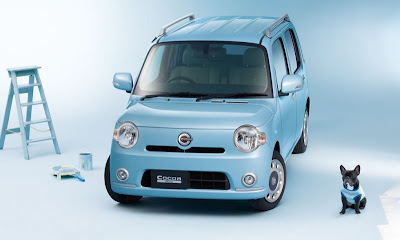
2010 Daihatsu Mira Cocoa Cute Car

2010 Daihatsu Mira Cocoa2010 Daihatsu Mira Cocoa

2010 Daihatsu Mira Cocoa2010 Daihatsu Mira Cocoa rear view

2010 Daihatsu Mira Cocoa Interior2010 Daihatsu Mira Cocoa Interior

Monday, May 3, 2010

Daihatsu Charade

Daihatsu Charade, 2006


Ignoring hybrids, the Daihatsu Charade has arguably the world's most efficient 1.0 litre petrol engine with an unrivalled fuel economy, exhaust emission and performance combination.

The Daihatsu Charade is the UK's No 1 four-seater for petrol-engine economy with Urban/Extra Urban and Combined figures of 47.1/68.9 and 58.9 mpg in manual form.

The 58.9 mpg figure is a staggering 14.1 mpg better than the Hyundai Amica 1.0, 11.8 mpg superior to a Fiat Seicento and leads the SEAT Arosa 1.0 litre by 11.2 mpg.

All its city car rivals are substantially slower, failing to remotely match the Daihatsu Charade manual's 99.4 mph top speed or automatic's 93.1 mph maximum - and with much higher CO2 exhaust emissions.

In fact, the Daihatsu Charade manual's emissions of 114 g/km qualifies the owner for the lowest possible Road Fund Licence charge of £70 for 12 months (AA band up to 120 g/km).

Not to be outdone, the Daihatsu Charade automatic is also a class-leader with Urban/Extra Urban and Combined fuel economy figures of 38.7/55.4 and 47.9 mpg. Its CO2 exhaust emissions are an ultra-low 140 g/km. Naturally, the new car complies with Euro4 emission standards.

As for acceleration, the new Charade is also in a class of its own with 0-62 mph times of 12.2 seconds for the manual and 15 seconds for the automatic. To put this into context, the manual's figures precisely match the 1.4 litre 75 PS Peugeot 206.

Three Cylinder, Twin-Cam With Dynamic Variable Valve Timing
Daihatsu has long experience in the art of producing efficient small-capacity three cylinder engines which are currently offered on both the smaller Cuore and larger Sirion. A three-cylinder unit gives greater torque than a four with reduced internal friction - both ideal for maximising flexibility and efficiency.

The Daihatsu Charade's in-line 989 cc engine has a bore and stroke of 72 x 81 mm, a 10:1 compression ratio and features both twin-overhead camshafts with 12 valves and Dynamic Variable Valve Timing (DVVT).

DVVT provides even stronger low-speed pulling power - which results in fewer gear-changes - yet also increases power at the top-end of the engine's rev-range, boosting overtaking ability.

New features for the Charade include a resin port intake manifold and a head cover incorporating an air-cleaner case. Both reduce weight and strengthen torque in the most frequently used rev-range. Maximum power is 58.5 PS at 6,000 rpm with torque of 67.1 lb ft at 4,000 rpm.

Improved Transmission
Compared to the Cuore and Sirion, the new Daihatsu Charade has an improved five-speed manual transmission with a more precise, linear and direct shift feel.

Fourth and fifth gears pull a relatively high 17.8 and 21.7 mph per 1,000 rpm which reduces engine speed and therefore noise. The automatic transmission is a new 4-speed unit.

European Feel For Suspension
Daihatsu benchmarked the larger Renault Clio for ride and refinement, with extensive development work being undertaken on European roads.

The result is an especially long suspension stroke for the Charade's front and rear arrangement, both in compression and rebound. This provides a subtle, compliant ride but with firm damping control for reduced float.

The front suspension is by conventional MacPherson struts with coil springs and a new 'L' shaped lower arm which gives more precise control of wheel movement.

The rear suspension is via the well-proven semi-independent torsion bar system with separate coil springs. However, compared to other models, the shock-absorbers are mounted more vertically, again providing better damping control and reducing the transmission of road noise.

Standard High-Tech Power-Steering
The Daihatsu Charade's standard power steering uses the latest technology to provide optimum feel, quick responses and reduced fuel consumption.

Instead of relying on an engine-driven pump, the new speed-sensitive electric power steering comprises a torque sensor, computer and assist motor which barely require any energy to operate.

Because of its light weight and finely-tuned suspension, the new Daihatsu Charade can provide high levels of cornering grip with relatively narrow-section 155/65R13 tyres mounted on 13 x 4 ins steel or alloy wheels. This helps fuel economy thanks to a low rolling resistance.

'Best-In-Class' Braking Performance
As for braking performance, Daihatsu aims to provide 'best-in-class' stopping distances partly thanks to the excellent anti-dive characteristics of the front suspension.

In addition, the front disc pads are made from high-friction material and the tyres also benefit from high straight-line grip levels.

The Daihatsu Charade is fitted with solid front disc and rear drum brakes operated by an 8 ins servo unit. The anti-lock-braking system incorporated EBD (electronic brakeforce distribution). This optimises braking force according to the weight distribution of passengers and luggage.

'Best-In-Class' Refinement
Daihatsu again used the Renault Clio as its benchmark for NVH with the aim of being not only best in the city car class but also among superminis.

For example, special attention was placed on engine boom, idling shake, running vibration and wind noise - all areas which can contribute to a small car becoming tiring on a long journey.

The Charade's sector-leading aerodynamics of 0.31 Cd not only improves fuel economy and provides a higher top speed - it also makes the car quieter.
Apart from having a more rigid body than previous Daihatsus, the Charade features a new engine installation comprising three widely-spread mounting points employing soft rubber.
The system better dampens noise and vibration and reduces engine movement or 'shunt', especially when moving away from rest. An H-shaped front frame is also fitted, together with a performance rod to further reduce vibration.

Top-Level Safety Performance
Top-level safety performance is promised for the Daihatsu Charade with previously unheard of levels of passenger and pedestrian protection for such a small car.

The Daihatsu Charade complies with criterion comparable with a 4-Star Euro NCAP for passenger safety and 3-Star for pedestrian.

The platform is new and makes extensive use of high-strength steels for areas such as the floor pan, B-posts and front engine-mounting frame. This new energy-absorbing structure better disperses impact forces.

Designed to offer 'best-in-class' protection in 'real-world' accidents, the new Daihatsu Charade has a straight front side member with its end height at the same level as, for example a Toyota Corolla, Avensis or Lexus. Its car-to-car collision performance was designed around these considerably larger cars.

Other passive safety features include side-impact protection door beams, driver and passenger airbags plus the availability of side airbags. The front seatbelts are height-adjustable and feature both force-limiters and pre-tensioners. Both front and rear seats have adjustable head restraints.

The new Charade features Daihatsu's impact-sensing release system. During a collision it unlocks the doors and turns on the interior light and hazard warning lights to enable easier escape or rescue.

Daihatsu Charade

Daihatsu Charade, 2006


Ignoring hybrids, the Daihatsu Charade has arguably the world's most efficient 1.0 litre petrol engine with an unrivalled fuel economy, exhaust emission and performance combination.

The Daihatsu Charade is the UK's No 1 four-seater for petrol-engine economy with Urban/Extra Urban and Combined figures of 47.1/68.9 and 58.9 mpg in manual form.

The 58.9 mpg figure is a staggering 14.1 mpg better than the Hyundai Amica 1.0, 11.8 mpg superior to a Fiat Seicento and leads the SEAT Arosa 1.0 litre by 11.2 mpg.

All its city car rivals are substantially slower, failing to remotely match the Daihatsu Charade manual's 99.4 mph top speed or automatic's 93.1 mph maximum - and with much higher CO2 exhaust emissions.

In fact, the Daihatsu Charade manual's emissions of 114 g/km qualifies the owner for the lowest possible Road Fund Licence charge of £70 for 12 months (AA band up to 120 g/km).

Not to be outdone, the Daihatsu Charade automatic is also a class-leader with Urban/Extra Urban and Combined fuel economy figures of 38.7/55.4 and 47.9 mpg. Its CO2 exhaust emissions are an ultra-low 140 g/km. Naturally, the new car complies with Euro4 emission standards.

As for acceleration, the new Charade is also in a class of its own with 0-62 mph times of 12.2 seconds for the manual and 15 seconds for the automatic. To put this into context, the manual's figures precisely match the 1.4 litre 75 PS Peugeot 206.

Three Cylinder, Twin-Cam With Dynamic Variable Valve Timing
Daihatsu has long experience in the art of producing efficient small-capacity three cylinder engines which are currently offered on both the smaller Cuore and larger Sirion. A three-cylinder unit gives greater torque than a four with reduced internal friction - both ideal for maximising flexibility and efficiency.

The Daihatsu Charade's in-line 989 cc engine has a bore and stroke of 72 x 81 mm, a 10:1 compression ratio and features both twin-overhead camshafts with 12 valves and Dynamic Variable Valve Timing (DVVT).

DVVT provides even stronger low-speed pulling power - which results in fewer gear-changes - yet also increases power at the top-end of the engine's rev-range, boosting overtaking ability.

New features for the Charade include a resin port intake manifold and a head cover incorporating an air-cleaner case. Both reduce weight and strengthen torque in the most frequently used rev-range. Maximum power is 58.5 PS at 6,000 rpm with torque of 67.1 lb ft at 4,000 rpm.

Improved Transmission
Compared to the Cuore and Sirion, the new Daihatsu Charade has an improved five-speed manual transmission with a more precise, linear and direct shift feel.

Fourth and fifth gears pull a relatively high 17.8 and 21.7 mph per 1,000 rpm which reduces engine speed and therefore noise. The automatic transmission is a new 4-speed unit.

European Feel For Suspension
Daihatsu benchmarked the larger Renault Clio for ride and refinement, with extensive development work being undertaken on European roads.

The result is an especially long suspension stroke for the Charade's front and rear arrangement, both in compression and rebound. This provides a subtle, compliant ride but with firm damping control for reduced float.

The front suspension is by conventional MacPherson struts with coil springs and a new 'L' shaped lower arm which gives more precise control of wheel movement.

The rear suspension is via the well-proven semi-independent torsion bar system with separate coil springs. However, compared to other models, the shock-absorbers are mounted more vertically, again providing better damping control and reducing the transmission of road noise.

Standard High-Tech Power-Steering
The Daihatsu Charade's standard power steering uses the latest technology to provide optimum feel, quick responses and reduced fuel consumption.

Instead of relying on an engine-driven pump, the new speed-sensitive electric power steering comprises a torque sensor, computer and assist motor which barely require any energy to operate.

Because of its light weight and finely-tuned suspension, the new Daihatsu Charade can provide high levels of cornering grip with relatively narrow-section 155/65R13 tyres mounted on 13 x 4 ins steel or alloy wheels. This helps fuel economy thanks to a low rolling resistance.

'Best-In-Class' Braking Performance
As for braking performance, Daihatsu aims to provide 'best-in-class' stopping distances partly thanks to the excellent anti-dive characteristics of the front suspension.

In addition, the front disc pads are made from high-friction material and the tyres also benefit from high straight-line grip levels.

The Daihatsu Charade is fitted with solid front disc and rear drum brakes operated by an 8 ins servo unit. The anti-lock-braking system incorporated EBD (electronic brakeforce distribution). This optimises braking force according to the weight distribution of passengers and luggage.

'Best-In-Class' Refinement
Daihatsu again used the Renault Clio as its benchmark for NVH with the aim of being not only best in the city car class but also among superminis.

For example, special attention was placed on engine boom, idling shake, running vibration and wind noise - all areas which can contribute to a small car becoming tiring on a long journey.

The Charade's sector-leading aerodynamics of 0.31 Cd not only improves fuel economy and provides a higher top speed - it also makes the car quieter.
Apart from having a more rigid body than previous Daihatsus, the Charade features a new engine installation comprising three widely-spread mounting points employing soft rubber.
The system better dampens noise and vibration and reduces engine movement or 'shunt', especially when moving away from rest. An H-shaped front frame is also fitted, together with a performance rod to further reduce vibration.

Top-Level Safety Performance
Top-level safety performance is promised for the Daihatsu Charade with previously unheard of levels of passenger and pedestrian protection for such a small car.

The Daihatsu Charade complies with criterion comparable with a 4-Star Euro NCAP for passenger safety and 3-Star for pedestrian.

The platform is new and makes extensive use of high-strength steels for areas such as the floor pan, B-posts and front engine-mounting frame. This new energy-absorbing structure better disperses impact forces.

Designed to offer 'best-in-class' protection in 'real-world' accidents, the new Daihatsu Charade has a straight front side member with its end height at the same level as, for example a Toyota Corolla, Avensis or Lexus. Its car-to-car collision performance was designed around these considerably larger cars.

Other passive safety features include side-impact protection door beams, driver and passenger airbags plus the availability of side airbags. The front seatbelts are height-adjustable and feature both force-limiters and pre-tensioners. Both front and rear seats have adjustable head restraints.

The new Charade features Daihatsu's impact-sensing release system. During a collision it unlocks the doors and turns on the interior light and hazard warning lights to enable easier escape or rescue.

Monday, April 19, 2010

Monday, March 15, 2010

Daihatsu Materia

Daihatsu Materia


Powered by a lively 103.3 PS 1.5 litre petrol engine, the Daihatsu Materia is both economical at 46.3 mpg on the Extra Urban Cycle (manual) and 45.6 mpg (automatic) and offers a 100-plus mph top speed. This leaves plenty in reserve for comfortable long-distance motorway travel.

Daihatsu Materia Design Concept
The Materia's funky yet practical shape maximises interior space and was designed to be both distinctive and spirited. It is sold as both a Toyota and Daihatsu in Japan.

From the side, large 15 ins diameter spoked alloy wheels - linked by deep side skirts - further reinforce the message of stability. The generous 185/55 tyres combined with a wide track 'fill' the wheel openings.

Size Comparisons
The Daihatsu Materia's spacious cabin features both a generous interior width and length clothed in a compact body with excellent manoeuvrability thanks to good visibility and a tight 9.8 metre turning circle (kerb-to-kerb).

Its overall length of 3,800 mm is between the Renault Modus (3,792 mm) and Vauxhall Meriva (4,042 mm). The Daihatsu's width of 1,690 mm is almost identical to the 1,695 mm of the Renault and 1,694 mm of the Vauxhall.

The Materia's 1,635 mm height compares with the1,589 mm of the Modus and 1,624 mm of the Meriva, while the Daihatsu's wheelbase of 2,540 mm exceeds the 2,482 mm of the Renault but is slightly shorter than the Vauxhall's 2,630 mm.

Its 1,420 mm interior width far exceeds the Renault Modus which can only offer 1,280 mm. This, combined with an interior length of 1,950 mm (Vauxhall Meriva 1,825 mm) offers outstanding useable space.
The Daihatsu Materia offers 619 litres of load space with the rear seat folded and either 294 or 181 litres with the rear seat upright (VDA) depending on whether the seat is slid forward or backwards.
Versatile, Funky-Looking Interior
The Materia's stylish and versatile interior includes a rear seat that has a rake-adjustable backrest which can also be fully reclined to form a bed, joining the equally fully-reclining front seats.

The rear seat also features a 60/40 split plus fore and aft slide adjustment of 160 mm. This allows a fully-flexible rear legroom/load space compromise. The rear tailgate opening is flush with the load floor for easy loading and unloading.

A compartment under the rear floor allows the storage of various items such as tools, while a deep bottle holder is also included in the side of the luggage compartment. Interior bottle holders can be found in both front and rear doors plus four in the centre console.

Lively, Frugal, Advanced Petrol Engine
The new Daihatsu Materia features a lively and frugal 1.5 litre petrol engine offered with the choice of either five-speed manual of four-speed automatic transmission.
The engine itself is highly advanced and is similar to that fitted to the Daihatsu Terios compact SUV and can also be seen in 1.3 litre form in the Sirion supermini.

Featuring Dynamic Variable Valve Timing (DVVT) which enhances low-speed pulling power and high-rev response, the twin overhead camshaft unit is compact and light, with an alloy head and block.
Power is 103.3 PS at 6,000 rpm with torque of either 97.4 lb ft at 4,400 rpm for the Daihatsu Materia manual or 101.8 lb ft in the automatic. The engine has a 10.0:1 compression ratio and features a bore and stroke of 72 x 91.8 mm.

The five-speed manual gearbox and four-speed automatic both have carefully chosen ratios that provide sprightly acceleration from standstill yet relaxed cruising.

World's First Self-Regenerating Catalyst
The new Sirion 1.3 litre launched in 2005 featured the world's first self-regenerating catalyst. This innovation is also standard on the new Copen 1.3 and now the new 1.5 litre Daihatsu Materia.

European-Tuned Chassis
Daihatsu has tuned the Materia's chassis for European markets and the result is a firmly-damped but smooth ride and excellent control of body roll despite the car's higher-than average stance.

The power-steering is well-weighted, with good straight-line stability and reassuring self-centring. Meanwhile, the front and rear anti-roll bars coupled with generous low-profile tyres keep understeer well in check.

Front suspension is by MacPherson struts with a long-travel design for an absorbent ride, while the anti-roll bar - specially developed for export - reduces body lean.

The Daihatsu Materia has a conventional hydraulic power-assisted rack-and-pinion steering system as opposed to the growing trend towards electric power-assistance. The benefits are greater feel and sensitivity.


High Safety Levels
Safety is given high priority in the Daihatsu Materia, especially considering its likely roll as a family car. It therefore has all the latest life-saving and injury-reducing initiatives.

Should parents wish to carry their offspring in a child seat placed on the front passenger seat, a switch can be used to disable the passenger airbag.

Twin front airbags and side airbags are also standard as are dual side-impact door beams. The body structure is designed to absorb all-angle impacts while maintaining survival space around the occupants.

The braking system features servo-assisted front ventilated disc brakes and rear drums. Anti-lock (ABS) is also standard as is Electronic Brakeforce Distribution (EBD) which further avoids the locking-up of individual wheels during severe braking.